Hardware

The phones we actually put on desks

We standardize on Grandstream. One manufacturer means one provisioning process, one firmware track and one set of spares, which is why installs go quickly and support calls are short. Here is what each one is for.

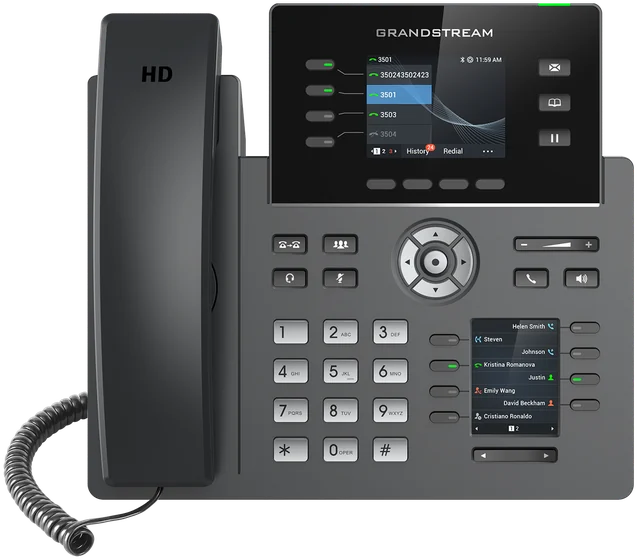
Grandstream GRP2616 desk phone, front view

Our standard phone

GRP2616

Who it is for: Almost everybody. Front office, sales, management, anyone with a desk.

This is the phone we put on most desks, and unless something about your setup says otherwise it is the one you will get. Color display, gigabit network pass-through so it shares the one cable with your computer, and power over Ethernet so it needs no plug. Bluetooth and Wi-Fi are built in, which matters in the rooms where running a second cable is a job in itself.

  • Enough line and speed-dial keys for a normal working day without an add-on
  • Gigabit pass-through, so one network cable serves the phone and the PC
  • Power over Ethernet, no power brick at the desk
  • Bluetooth and Wi-Fi built in for awkward rooms and headsets
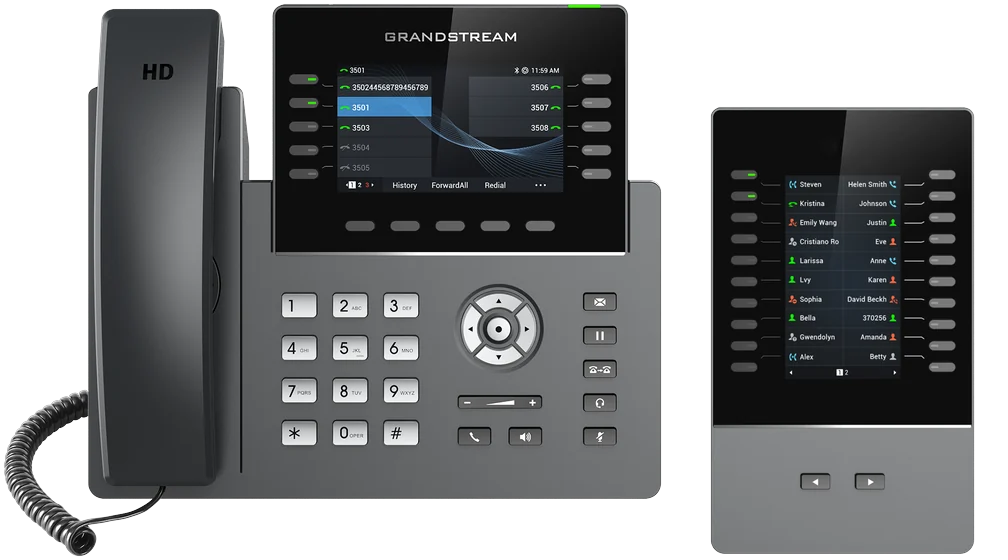
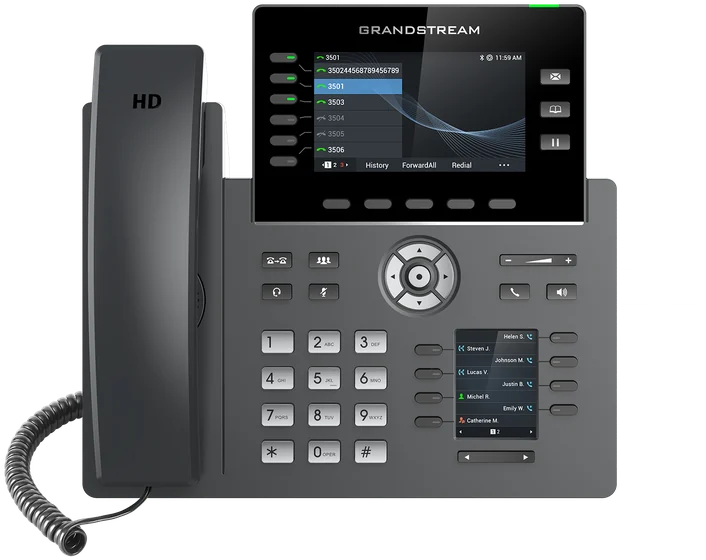
Grandstream GRP2615 desk phone beside a GBX20 expansion module

For watching a lot of extensions

GRP2615 + GBX20

Who it is for: Receptionists, dispatchers, schedulers, anyone who answers for other people.

Same family, but built to take expansion modules. If somebody needs to see at a glance who is on the phone across the whole company, and transfer to them with one press, this is the combination: the GRP2615 with one or more GBX20 sidecars beside it. Each sidecar adds a bank of physical keys, so busy lamp fields stay on buttons rather than buried in a menu.

  • Add GBX20 sidecars for as many extensions as the desk needs to watch
  • Physical keys with busy lamp status, not a screen you have to scroll
  • One-press transfer to anyone on the board
  • The right answer for a front desk covering a whole company
Grandstream GRP2614 desk phone, front view

Smaller desks and shared spaces

GRP2614

Who it is for: Second desks, break rooms, workshops, warehouses, back offices.

A smaller footprint for desks that do not have room for a full phone, and for the places that simply need a handset within reach rather than a full workstation. The kitchen phone, the bench phone, the spare office. Same platform and same provisioning as the rest, so it is not a different thing to look after.

  • Takes up less desk than the 2616
  • Ideal as a kitchen, warehouse or workshop phone
  • Same provisioning and firmware as every other phone on the account
  • A sensible second phone for people who already have one
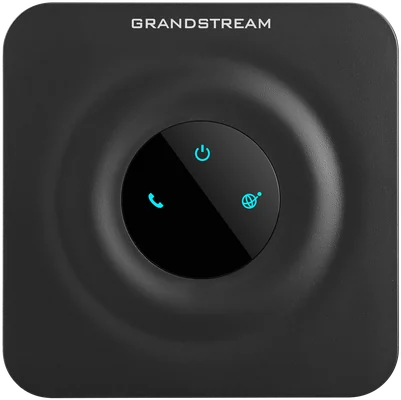
Grandstream HT801 single-port analog telephone adapter

Keep the equipment you already have

HT801

Who it is for: Fax machines, overhead paging, elevator and gate phones, legacy handsets.

A single-port analog adapter. It puts one ordinary analog device onto the phone system, which is how you keep the things that are not really phones: a fax machine, an overhead pager, the lift phone, a gate intercom, or a cordless base nobody wants to replace yet. Small box, one socket, no drama.

  • One analog port, for one existing device
  • The usual way to keep a fax line working after a switch
  • Common for paging, elevator phones and gate intercoms
  • Lets you move to VoIP without throwing away working equipment
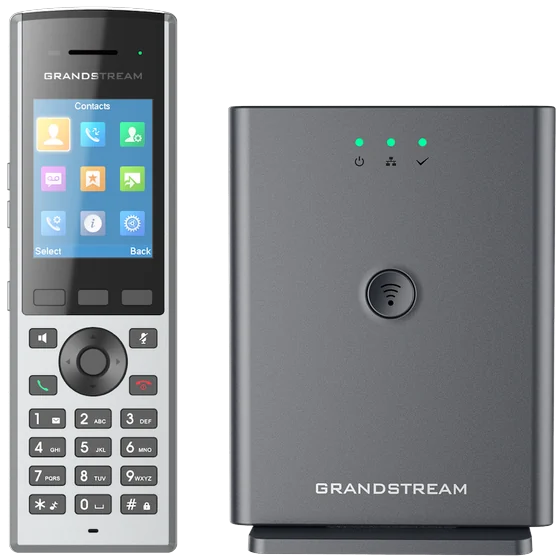
Grandstream DP730 cordless handset beside its DP752 base station

For people who do not sit down

DECT cordless

Who it is for: Shop floors, yards, clinics, restaurants, anywhere staff are on the move.

A DECT base station with cordless handsets that roam across a building or a site. Longer range and much better battery life than carrying a mobile on Wi-Fi, and the calls stay on your phone system, so the extension, the transfers and the voicemail all work exactly as they do on a desk.

  • Roams across a building or yard on one base
  • Multiple handsets per base station
  • Behaves like any other extension: transfer, voicemail, the lot
  • Better battery and range than a phone app over Wi-Fi

Not sure which you need?

The honest short version, in the order we actually ask it.

  1. Start with the GRP2616

    If nothing below applies to a person, this is their phone. Most of any order is this model.

  2. Count who answers for other people

    Anyone covering a team or a whole company gets a GRP2615 and as many GBX20 sidecars as they need extensions to watch.

  3. Then count the places, not the people

    Kitchens, workshops, warehouses and spare offices need a phone in the room even though nobody sits there. That is the GRP2614.

  4. List anything that is not a phone

    Fax, paging, gate and elevator phones each need an HT801 to join the system.

  5. Last, anyone who does not sit down

    If somebody is on their feet all day, a DECT handset beats a desk phone and beats an app on a mobile.

Hardware rental is available on all plans, so the phones do not have to be an up-front purchase.

Ready for a phone bill that makes sense?

Tell us how many people need a phone and we will send you a real number, not a form letter.

Request a quote 580-576-8484